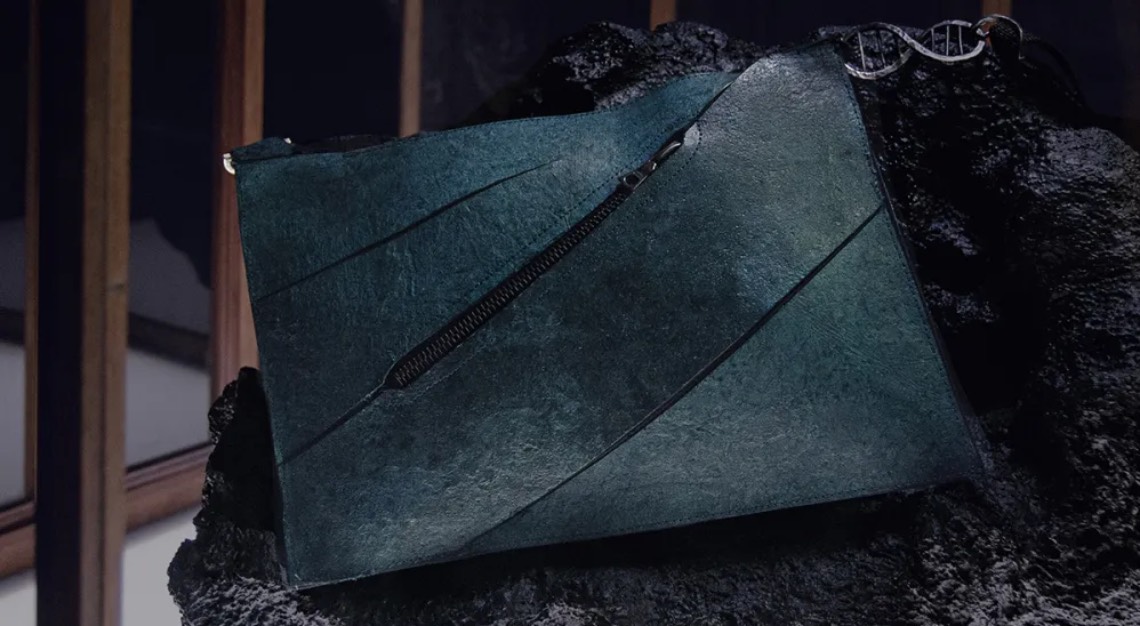
The clutch will be auctioned off in May with a reported starting price of more than half a million dollars
Who needs cow hide when your next tote could be made from dinosaur?
A luxury handbag crafted using a new type of “T-Rex Leather” was recently unveiled at the Art Zoo Museum in Amsterdam, underscoring the rise of lab-grown leathers.
The biomaterial was developed by creative agency VML—which co-created the Mammoth Meatball in 2023—in collaboration with the Organoid Company and Lab-Grown Leather. The team says the leather was engineered using reconstructed dinosaur collagen and brought to life without harming a single animal.
Scientists started by extracting fossilised collagen sequences from Tyrannosaurus rex fossils found in the U.S., then reconstructed the remaining genetic information to form a complete collagen blueprint. This fully synthesised DNA was inserted into an unidentified “carrier” animal’s cell to produce collagen that was turned into leather. The team says the resulting material is “structurally identical to traditional leather,” but is traceable, biodegradable, cruelty-free, and eco-friendly.
The T-Rex Leather was then sent to techwear specialist Enfin Levé to be turned into a handbag. Founded by Polish designer Michal Hadas, the Berlin-based label specializes in crafting high-performance clothing in innovative, technical fabrics, making it particularly well-suited for this project. The end product showcases a striking deep teal hue, a sleek, angular silhouette, and three decorative incisions that look a little like dinosaur scratch marks.
It is difficult to categorize it as a “luxury bag,” given that we can’t inspect the quality or finish. It is also hard to say whether “T-Rex Leather” is an appropriate name for the material, with some scientists outside the project expressing scepticism about the term since other animals are needed to produce it. Dutch vertebrate paleontologist Melanie During of the Vrije Universiteit Amsterdam told Reuters that collagen can persist in dinosaur bones only as fragmented traces, which cannot be used to recreate T. rex skin or leather. Still, those ancient T.Rex collagen sequences are intrinsic to the new leather.
Several start-ups are already offering low-impact, man-made alternatives to traditional fibres, with houses such as Hermès embracing mushroom leather to meet a growing demand for sustainable luxury. T-Rex Leather will be made available to luxury brands in the future, with details on purchasing and supply released in due course. It will initially be used for high-end accessories, with long-term plans to roll it out beyond fashion and into other sectors, such as automotive.
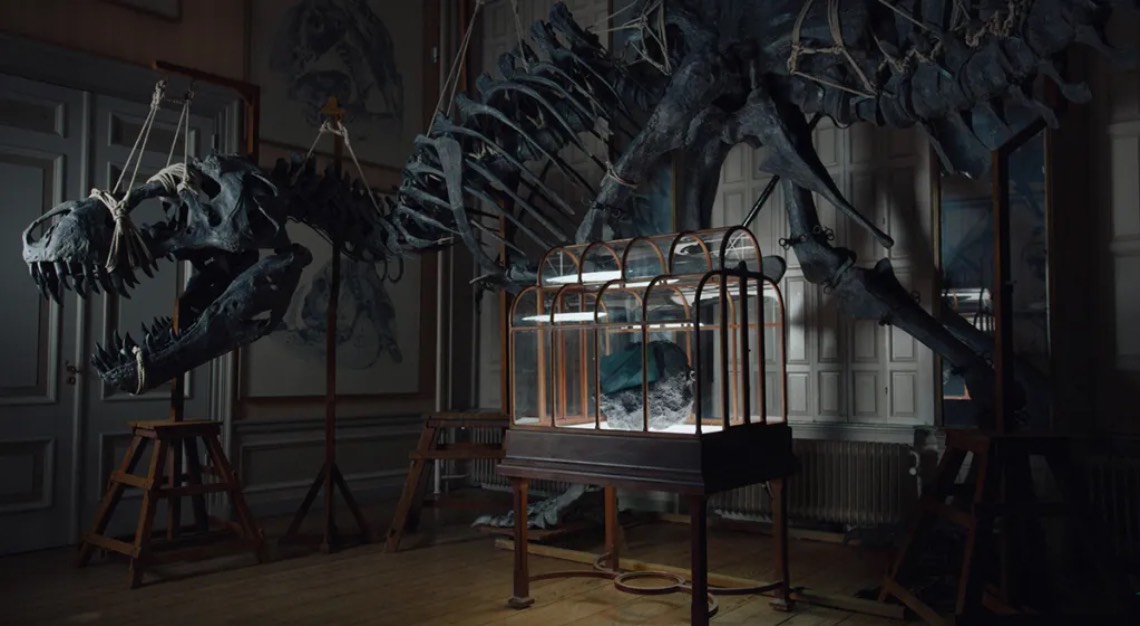
The T-Rex Leather bag will be displayed alongside a colossal T.Rex skeleton at the museum until 11 May 2026, after which it will be auctioned off with a reported starting price of more than half a million dollars.
This story was first published on Robb Report USA. Featured photo by VML