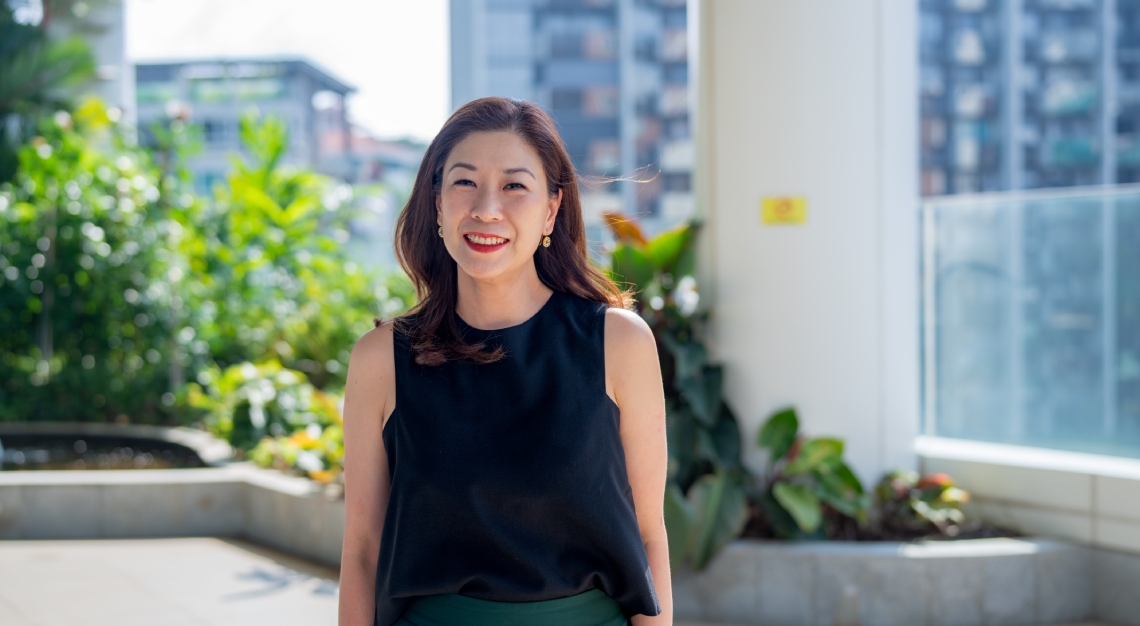
Temasek Shophouse’s CEO Yvonne Tay envisions an outdoor community space that brings together biodiversity and climate resilience within its conserved early-1900s shophouses
Tucked into a quiet corner of Orchard Road, Temasek Shophouse is both a conservation project and a live experiment in sustainable urban design. The project’s central lesson is that sustainability in a heritage building resists singular solutions. It is a question of integration: reducing energy consumption, managing water and materials, and shaping how people move through and experience the space every day.
“We’ve also come to appreciate that sustainability goes beyond building performance and carbon emissions,” says Yvonne Tay, CEO of Temasek Shophouse. “It is equally about creating a space that supports well-being, community, and everyday use—a place where people feel comfortable, welcomed, and connected.”
This is not a beautification exercise. Temasek Shophouse is on track to become Singapore’s first heritage shophouse to achieve the BCA Green Mark Platinum Zero Energy and WELL Platinum certifications, positioning it as a model for what a regenerative conserved building can, and should, look like.
We never saw Temasek Shophouse as just a building. It was always about connecting communities to what we do. Extending sustainability and engagement beyond the building allows the team to connect meaningfully with both the community and the natural environment. The outdoor space creates opportunities for people to gather, rest and participate in programmes in an open and accessible setting.
In Singapore, there is already a broader shift towards adaptive reuse, with heritage buildings being reimagined as functional spaces, from cultural institutions and hotels to community hubs. This reflects a growing appreciation that reusing existing structures not only preserves heritage but also reduces environmental impact and contributes to sustainable urban development.
One of the more complex challenges came from the building itself. Comprising four shophouses from different eras, its uneven ceiling heights, varying layouts, and strict conservation rules ruled out standard modifications. Integrating solar panels proved challenging due to the pitched rooflines, which limited placement options. Standard cooling solutions were also not viable as airflow and thermal comfort had to be engineered across very different spaces. The team used detailed airflow modelling to determine where fans should be placed, how many were needed, and how they could work alongside the air-conditioning system, all while navigating existing beams, ceiling heights, and conservation requirements.
Passive design plays an important role in energy efficiency. Tinted glass was installed on doors and windows to reduce heat gain and keep interiors cooler, while lighting sensors that automatically switch off lights in unoccupied meeting rooms and staircases were incorporated. Through this expansion, the team learnt that achieving balance requires time, iteration and a willingness to work creatively within constraints. It meant bringing together the right partners, taking a holistic approach and making intentional choices at every step.
The experience of social impact should not stop at the doorstep. By designing the indoor and outdoor environments as one integrated whole, the team has created an inclusive living space that turns sustainability from something people read about into something they can experience directly. Through the community farm, Temasek Shophouse will host sustainability workshops, farm tours and regular farmers’ markets, offering visitors an interactive way to engage with social and environmental causes. As a social impact hub, Temasek Shophouse sees itself as a place where changemakers can collaborate, exchange ideas and bring social impact to life.
This story first appeared in the July 2026 issue. Purchase it as a print or digital copy, or consider subscribing to us here