On the Phantom’s 100th year, Rolls-Royce staged a one-day immersion in October, unveiling its most complex and technically ambitious Phantom Private Collection model
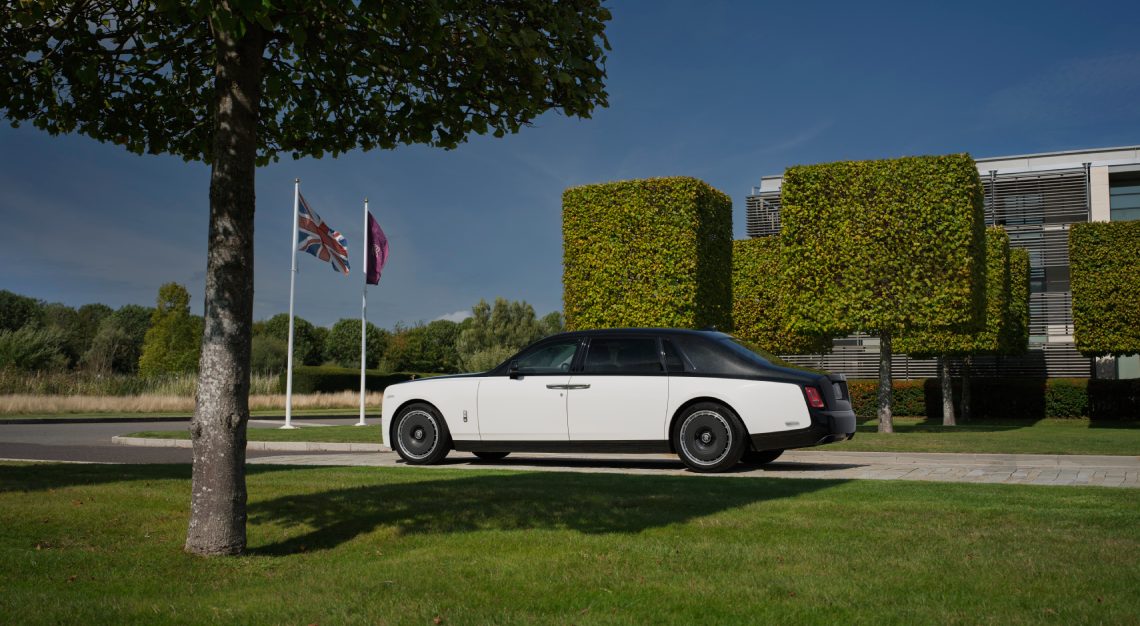
I arrive at Goodwood expecting spectacle. Yet what I find first is restraint: clipped hedgerows, low rooflines, and the kind of English green that conceals more than it reveals. One could look across the estate and never guess that a carmaker is based here, much less the house that builds Rolls-Royces by hand.
Inside, the choreography is quiet, rather than hushed. A gloved palm lays something impossibly fine onto wood; a laser traces a clean line across leather; fabric and thread draw images that appear only when one leans closer.
I am part of a global media contingent and we are being taken on a plant tour, which unfolds as a sequence of small astonishments. When it comes to the conceptualisation of the Phantom Centenary Private Collection, a designer shows us hand-drawn sketches and how each line is digitised before returning to life as a stitch, etch, veneer, or print. Another team describes techniques that were developed solely for this project: 3D marquetry that rises, 3D ink layering that adds dimension at scales almost too fine for the eye, and 24k gold leaves applied to wood so thin that it reads like light rather than metal.

The figures are remarkable: three years in development, over 40,000 collective hours, and a record number of designers and craftspeople involved. Yet what stands out most is how calm the work feels despite its complexity. One senses pride without performance.
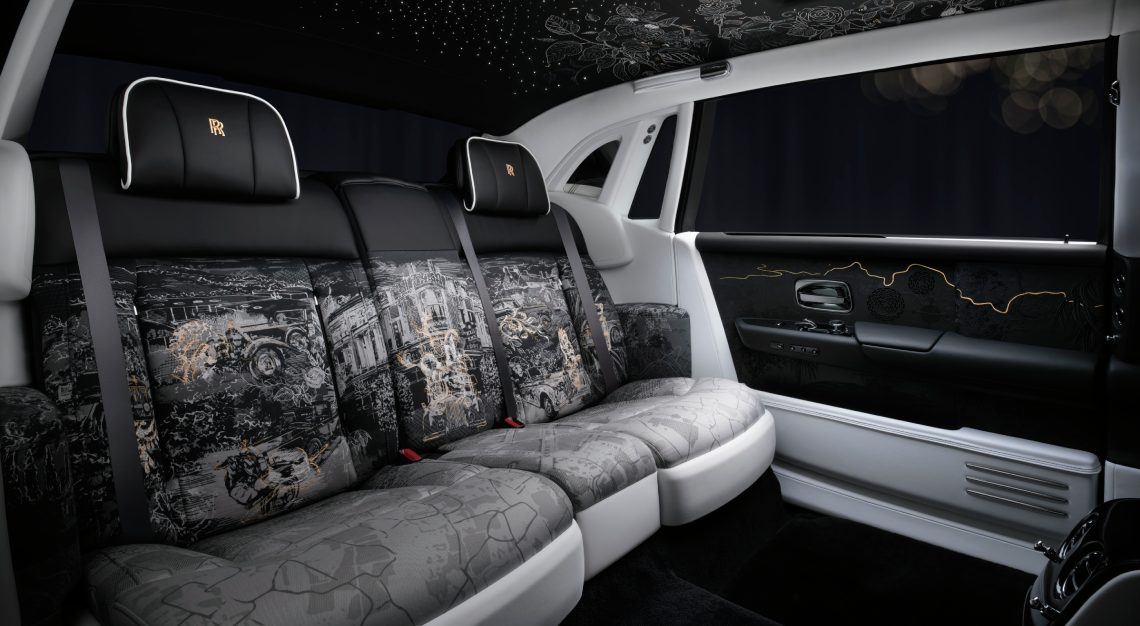
An artisan likens the process to “sketching with thread”, a phrase that resonates when we see the rear seats. These begin in a fashion atelier, where a high-resolution printed fabric is developed over 12 months before being embroidered into images that appear to float above the surface. Spanning 45 panels and around 160,000 stitches, this composition is the most intricate the marque has undertaken, yet the effect is gentle, almost domestic—like discovering a centuries- old tapestry.
Constant conversation
The commissioning rooms are where the hush makes the most sense. Here, Rolls-Royce remembers that the Phantom is a conversation, not a transaction. We see palettes and veneers, yes, but what lingers is the cadence: this, then that, then pause. Owners and designers decide what to reveal immediately and what to let unfold slowly over years of use.
The Anthology Gallery, a dramatic illuminated sculpture spanning the fascia, embodies that philosophy. Fifty brushed aluminium fins evoke the pages of a book, each engraved with sculpted letters forming excerpts from a century of acclaim. It is both overt and subtle—something to admire in passing, yet still capable of revealing new lines years later.
The theme continues onto the doors, where stained Blackwood becomes cartography. Maps, routes, and landscapes interlace with experimental Phantom motifs, the ‘roads’ rendered in hand-laid 24k gold leaf. Some details are near-microscopic—just 0.13mm high—rewarding those who look closely. We admire how the embroidery picks up where the veneer ends: gold thread continuing the journey across leather, as if time itself is being stitched together.
Stepping forward
At the unveiling, the room dims. Two early Phantoms from the 1920s frame the century. On one side is a handwritten client ledger; across the room, an original 1926 Phantom sketch—artefacts that make history feel vividly present.
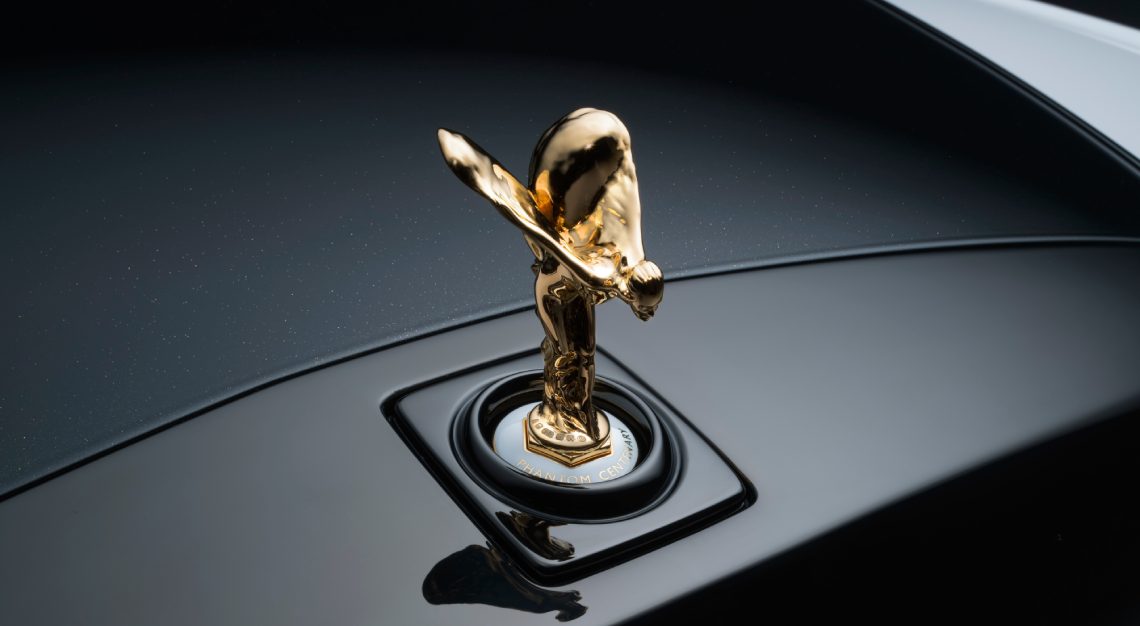
for permanence. Photo by Rolls-Royce Motor Cars
What follows feels less like an unveiling than a rite. The curtain rises and the golden glint appears first. The Spirit of Ecstasy is reinterpreted from the earliest Phantom, recast at a modern scale in solid 18k gold and plated in 24k for permanence. Even her base is ceremonial: hand-poured white vitreous enamel, the collection’s name inscribed with the restraint of a signet. For the first time, the RR Badge of Honour around the car is rendered in 24k gold and white enamel. It should not move you as a mascot, but it does.
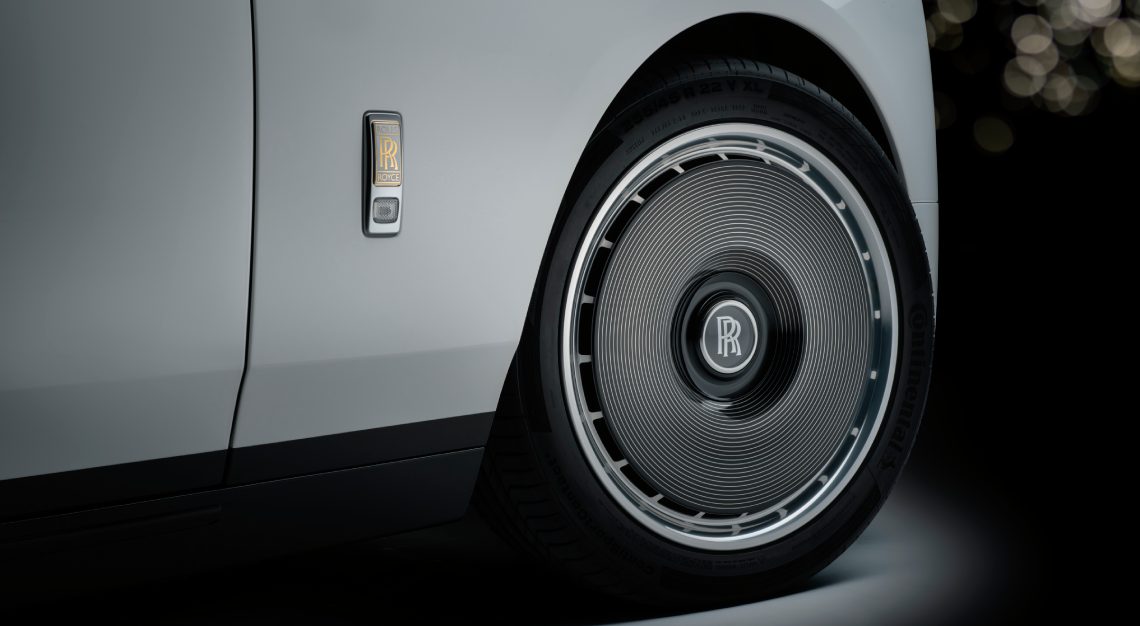
Look closer and another quiet gesture appears: disc wheels engraved with 25 lines each. Multiplied by four, they form the 100 lines marking every year of the Phantom’s life.
Inside, the century unfolds in stitch, print, and etch. The rear seats pay homage to the famed Phantom of Love, layered across three dimensions to tell stories of place, artefact, and seven significant owners rendered in abstract embroidery.
And above, the stars tell their own tale. The Starlight Headliner gathers a century into constellations: 100 mulberry leaves for the tree under which Sir Henry Royce and his engineers met, the square-crowned trees of Goodwood’s courtyard, the Phantom Rose that grows only here, bees for the on-site apiary, and a bluebird recalling Sir Malcolm Campbell’s Phantom II. Encyclopaedic in reference, yet soft in effect—the ceiling equivalent of a whispered toast.
A quiet legacy
What we keep thinking about is how little is demanded of us as an audience; no one tells us what to feel, no one rattles off superlatives from a lectern. Instead, the room is still and the car does all the talking. Or perhaps, what speaks most loudly is the work, tens of thousands of hours of care, expressed in miniature.
We’ve covered enough launches to know the difference between loud and lasting. This? This is lasting. We think it’s because the Phantom’s centenary is presented not as a history lesson, but more like a language you’d appreciate over time. Some words surface immediately, and others, you learn at your own pace; as if to say that every great story is also a journey.

Rolls-Royce had set out to honour 100 years of its most storied nameplate and, in doing so, is reminding us that luxury at this altitude is not volume, nor velocity, but pure control. Of materials, of meaning, and of mood.
Rolls-Royce will build only 25 examples of the Phantom Centenary Private Collection, each priced at approximately US$3 million. Twenty-five motor cars will carry that lesson into private lives. The rest of us carry the memory of a day when success sounded absolutely silent, and when memory, for a brief, brilliant hour, was forged in metal.