From tri-axial tourbillons to high-jewellery extravagance, Franck Muller’s latest novelties from WPHH 2026 reveal its fluency in the art of excess
They say a true artist knows when to hold back. Franck Muller, however, appears to reject this adage. A pioneer of independent horology, it has never been synonymous with restraint. While others have built entire identities around the discipline of ‘less is more’, Franck Muller has long operated from an exuberant conviction: that creativity, technical expertise, and visual allure should never be constrained.
This is, after all, the watchmaker that electrified collectors in the late 20th century with highly complicated watches that captivated both eye and mind. From a tourbillon with jumping hours in 1986 to an inverted tourbillon perpetual calendar with a minute repeater in 1989, Franck Muller’s early creations gave it a rebellious aura as it entered a pragmatic, post-quartz-crisis market.
It must be said, however, that there is more to Franck Muller than a fierce, almost counter-cultural streak. The maxim that one must master the rules before breaking them exists for a reason. Like a Jackson Pollock painting, what may at first appear spontaneous or chaotic reveals its sophistication the longer one observes.
One need only look at the brand’s latest novelties, unveiled at the 2026 World Presentation of Haute Horlogerie (WPHH). The array of eye-catching timepieces once again showcased Franck Muller’s flair, creativity, and technical fluency. From the openworked force of the Vanguard Aero Revolution 3 Skeleton to the brilliance of the Round Triple Mystery, the novelties reveal a brand for which breaking the boundaries of contemporary watchmaking is common practice.
Mechanical Poetry
Franck Muller’s flair for provocation feels most at home in the display of mechanical complexity. Known as the Master of Complications, it has made a habit of crafting calibres that impress on technical and visual levels.
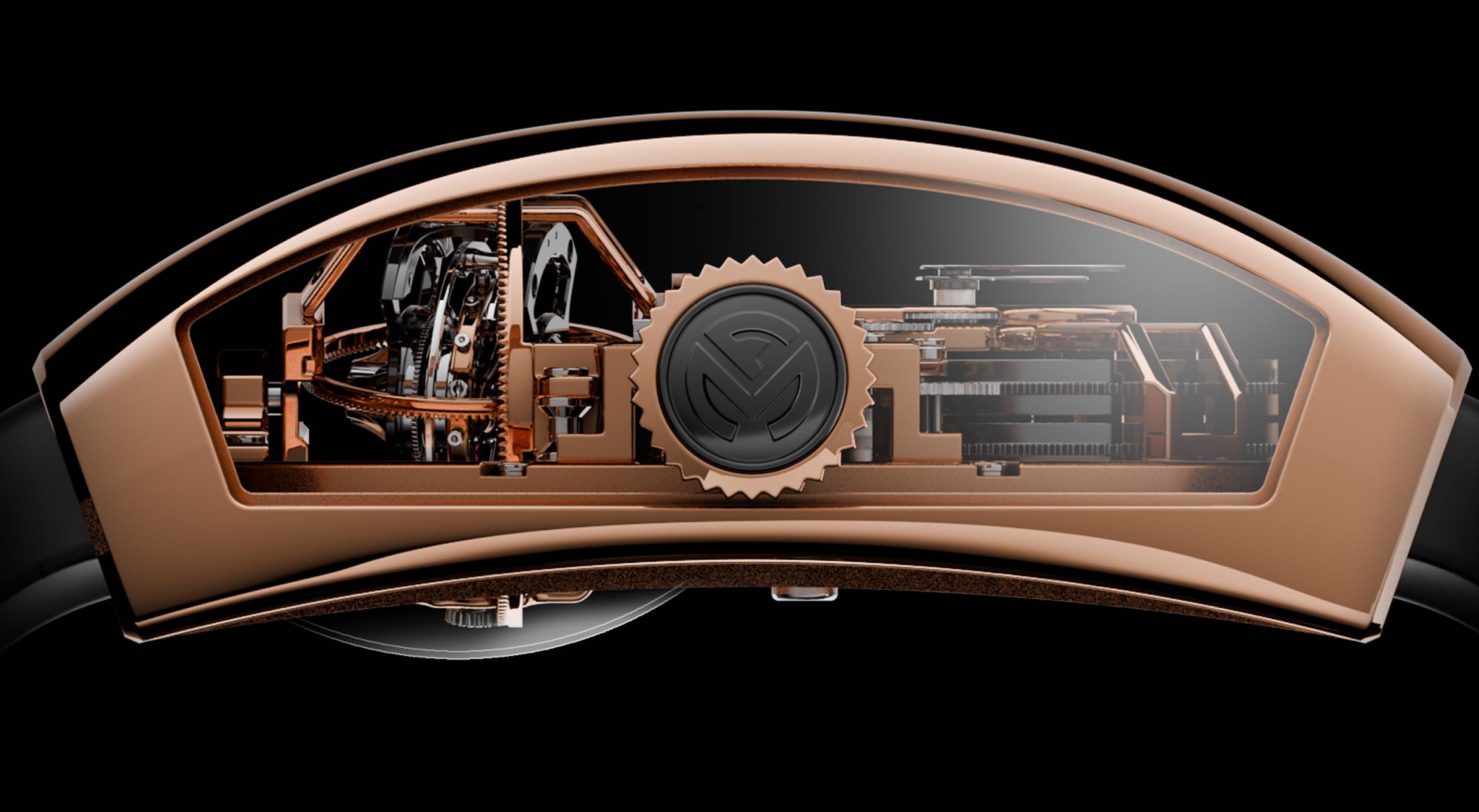
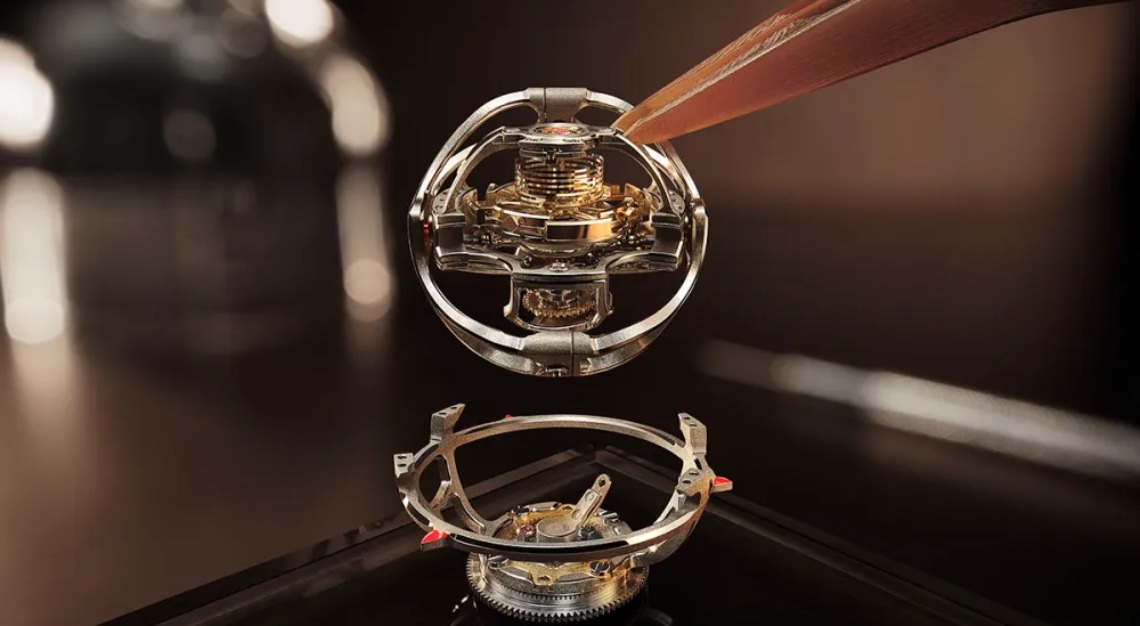
This may seem incongruent when looking at the new Vanguard Aero Revolution 3 Skeleton. With its almost entirely skeletonised architecture revealing the full splendour of the movement, the timepiece appears to possess a pared-back aesthetic. The technical expertise required to achieve this, however, is anything but restrained. At its core lies one of Franck Muller’s great technical accomplishments: the Revolution 3, a tri-axial tourbillon that made its world premiere in 2004.
Unlike a conventional tourbillon, which rotates the regulating organ on a single axis, the Revolution 3 multiplies that motion across three concentric cages that rotate at different speeds and on different axes: the inner cage completes a rotation every 60 seconds, the intermediate cage every eight minutes, and the outer cage every hour.
By continually changing the position of the balance wheel, the system is designed to compensate for the effects of gravity across multiple positions. The result is a tourbillon that mesmerises the eye as its three cages rotate at differing speeds and angles, giving the balance wheel a constantly shifting orientation.
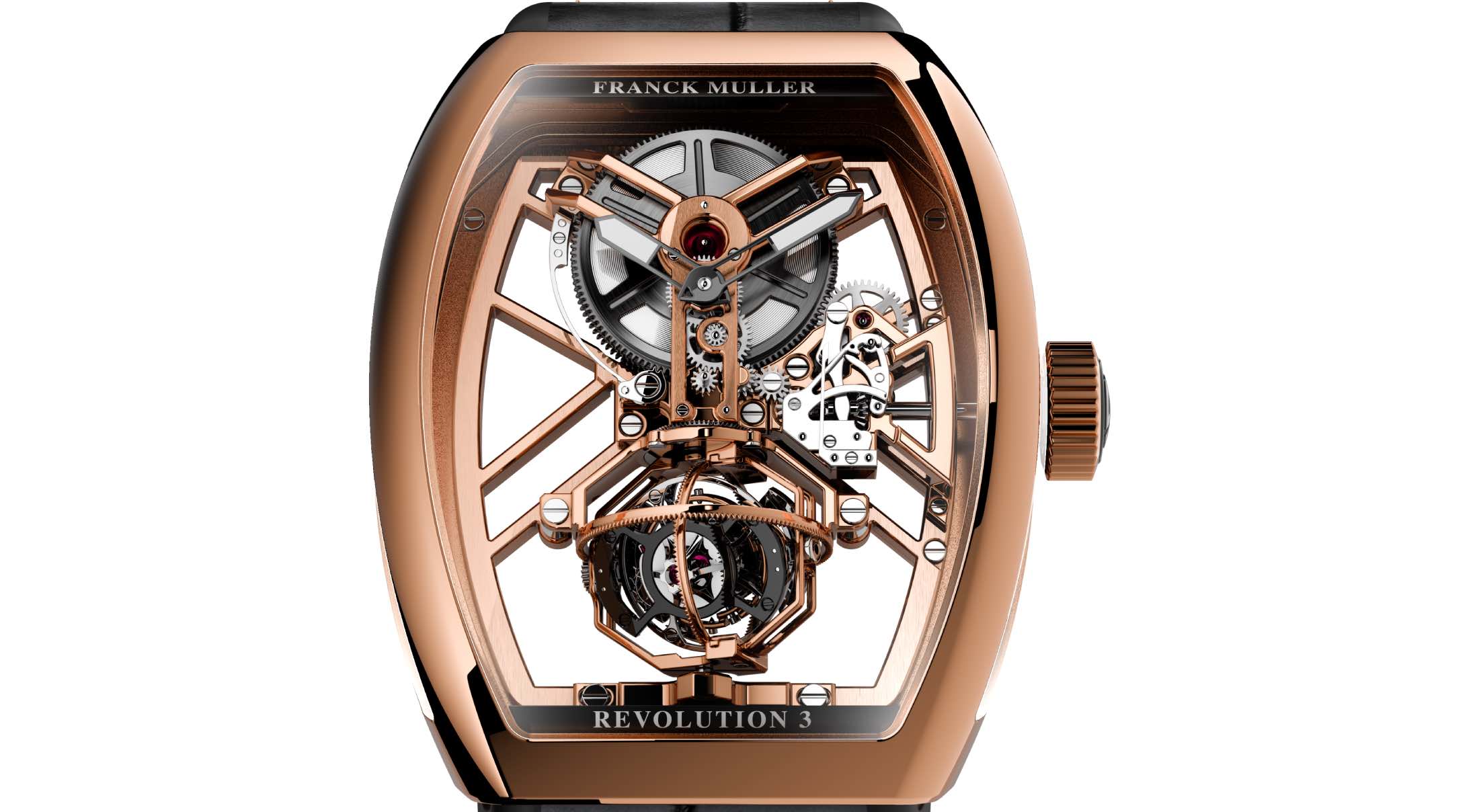
That visual ballet is amplified by the architecture of the watch. Developed in tandem, the case and movement of the Vanguard Aero Revolution 3 Skeleton are engineered to maximise visibility of the mechanism. The fully openworked case, measuring 43.9mm by 52.1mm, reveals the mechanism from the front, back, and sides.
Within it, the two-barrel calibre is mounted directly onto the sapphire caseback, an unprecedented configuration for the brand, while the lateral openings draw the eye into the layered movement architecture. And as if to further underline Franck Muller’s watchmaking pedigree, the movement delivers a 10-day power reserve, sustaining the constant motion of the tri-axial tourbillon with remarkable stamina.
Time in Motion
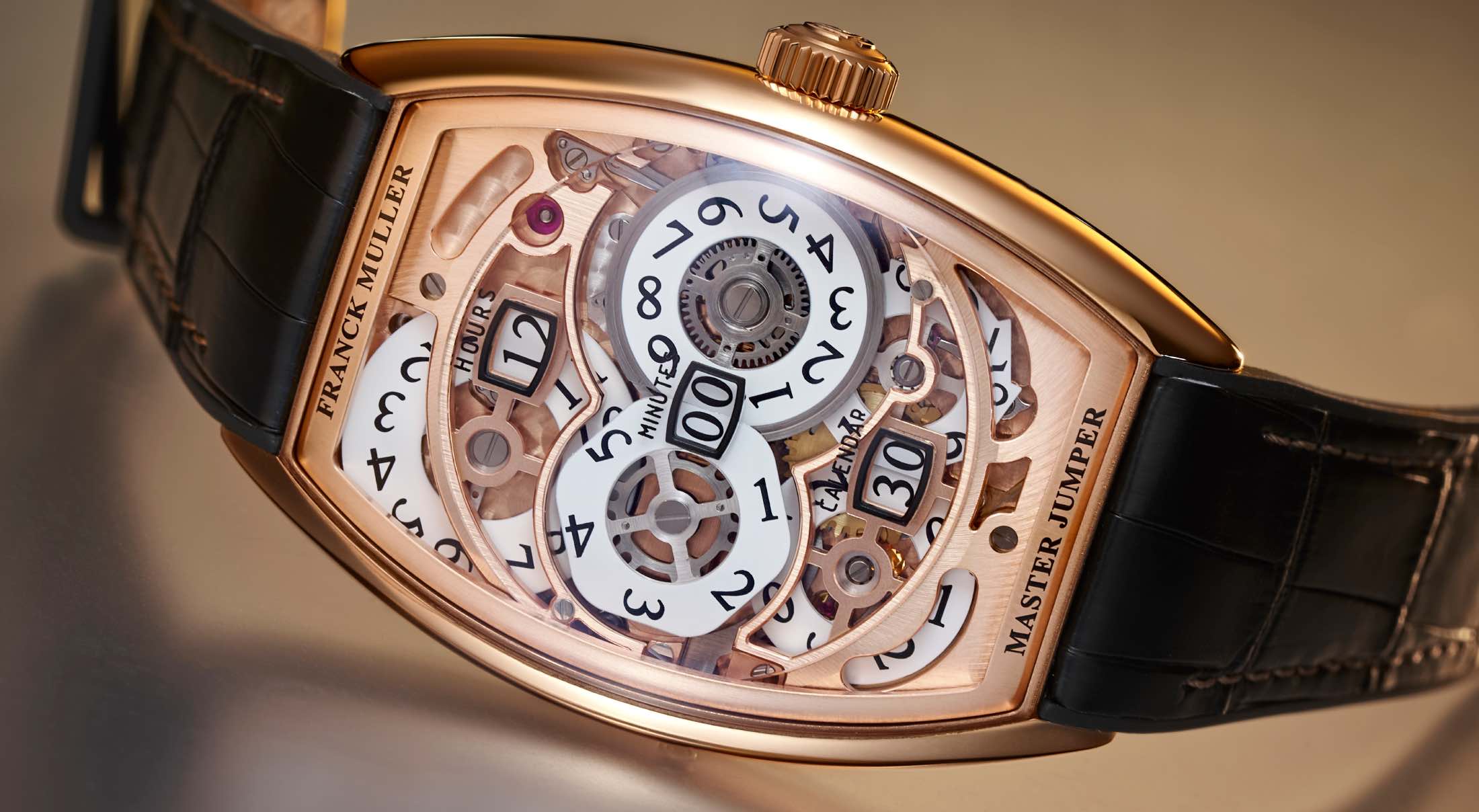
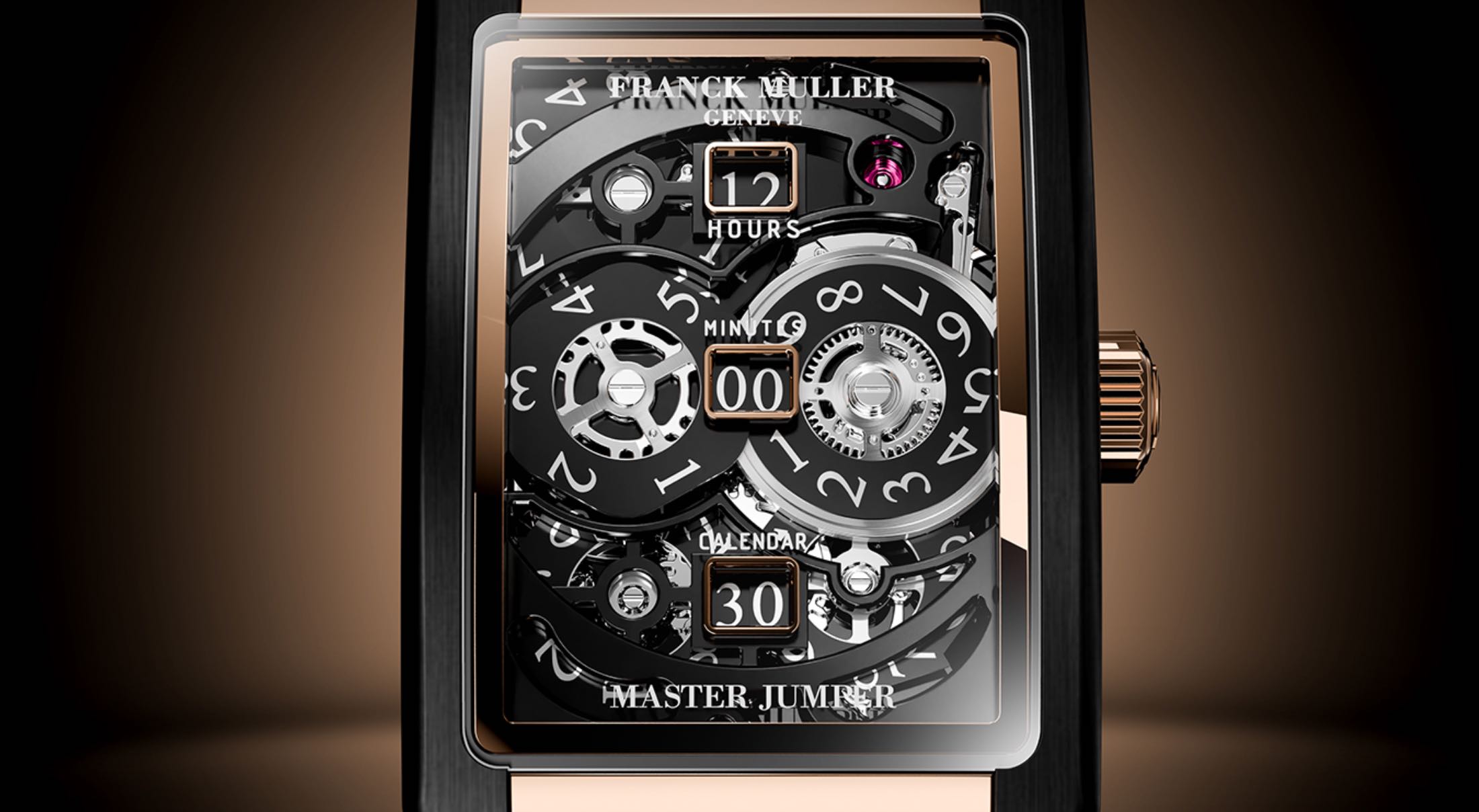
Franck Muller’s mechanical bravado extends to the way it displays time. Take the Master Jumper Skeleton, which arrives in two case silhouettes: the Long Island Evolution and Curvex CX. The watch displays the hours, minutes, and date through a triple-jumping complication, with the hours at 12 o’clock, the minutes at the centre, and the date at 6 o’clock.
The mechanism relies on five jumping discs, powered by a two-barrel architecture that divides the workload: one barrel drives the movement and date mechanism, while the other powers the minute discs and hour disc.
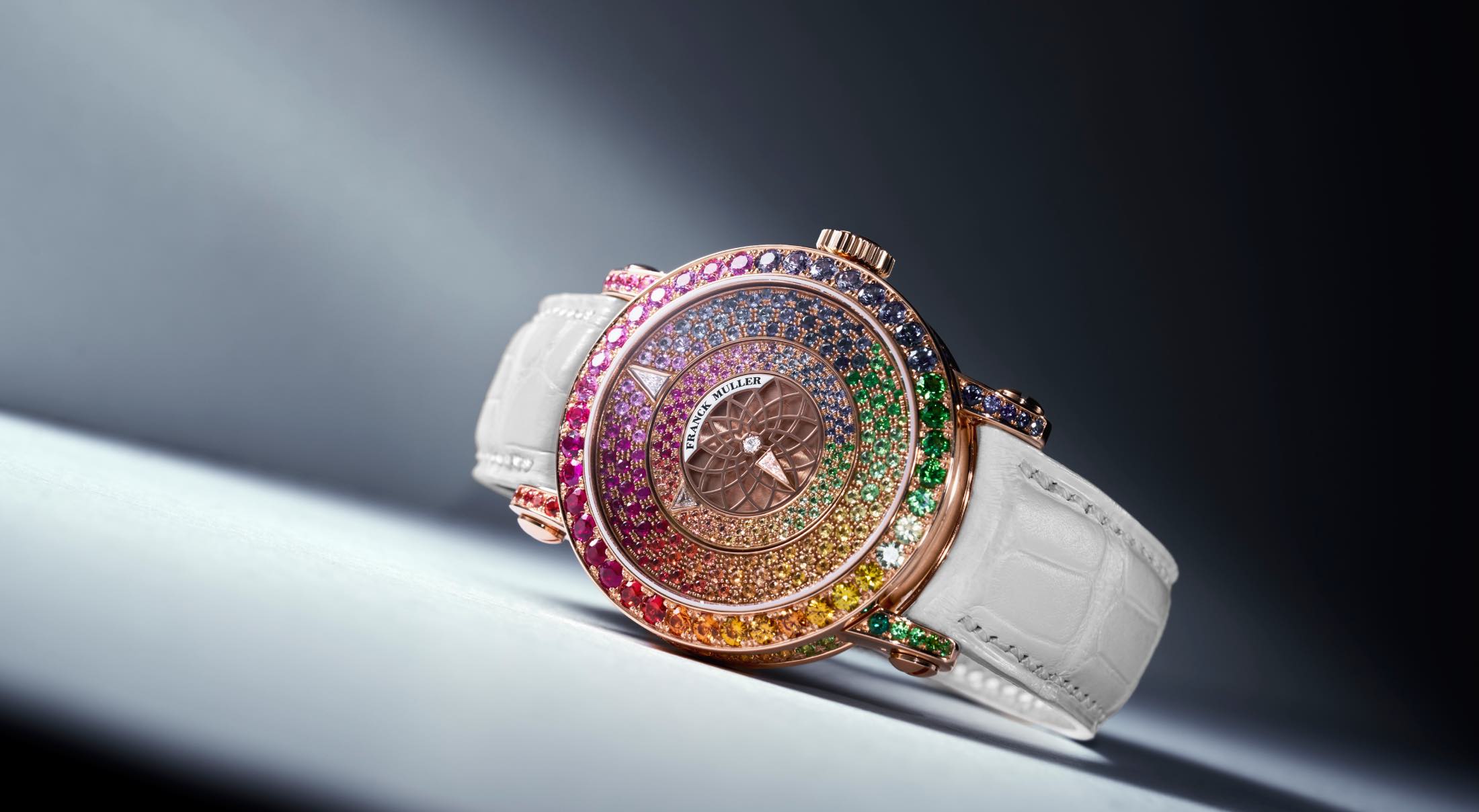
A more vivid expression of the brand’s ability to balance mind-bendingly complex horology with an eye-catching display, however, can be found in the Round Triple Mystery series. Built around the brand’s Mystery concept, the watch does away with traditional hands, instead using three rotating discs to indicate the hours, minutes, and seconds.
At the heart of the timepiece, the MVD 2800-TMY movement powers three independent rotating discs. To achieve this, Franck Muller designed a skeletonised central plate, combining rigidity with lightness so the display could move smoothly without compromising performance.
More than its mesmerising display, the timepiece is also a statement of Franck Muller’s high-jewellery savoir-faire. In the Round Triple Mystery Rainbow unveiled this year, sapphires, rubies, amethysts, and tsavorites are meticulously selected and arranged across the case in an orchestrated gradient, while the dial continues the composition with matching gemstones.
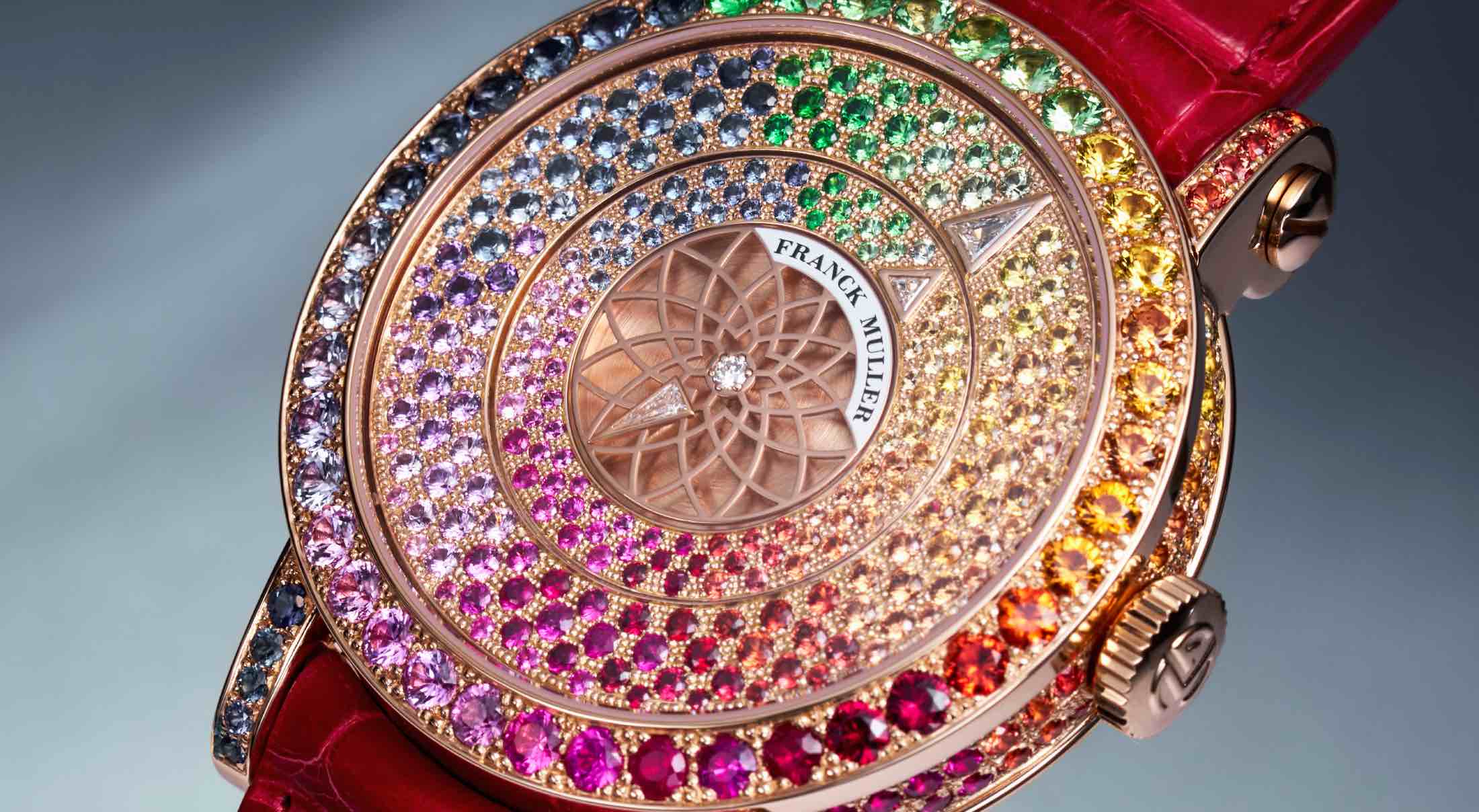
The Round Triple Mystery Rainbow is also available in a full baguette version, reimagining the composition through baguette-cut sapphires, rubies, amethysts, and tsavorites. Set without visible prongs using the brand’s invisible-setting technique, the stones create a seamless, architectural expression of high jewellery.
Dynamic Canvas
Franck Muller’s exuberance, however, is most vividly expressed in its artistic collaborations. The Vanguard Kelly Dabbah, created with the collage artist known for her multidisciplinary, maximalist body of work, translates Dabbah’s visual language into the Vanguard’s sporty tonneau silhouette. United by a shared appetite for bold aesthetics, the collection results in watches that exude dynamism and artistry.
This is achieved through a sublimation technique adapted from the art world for fine watchmaking. The intricate designs and patterns are printed using eco-friendly inks onto a special transfer film before being applied to the dial under heat and pressure. As the pigments penetrate the lacquer layer, the artwork becomes embedded into the material, resulting in a vivid and detailed image.
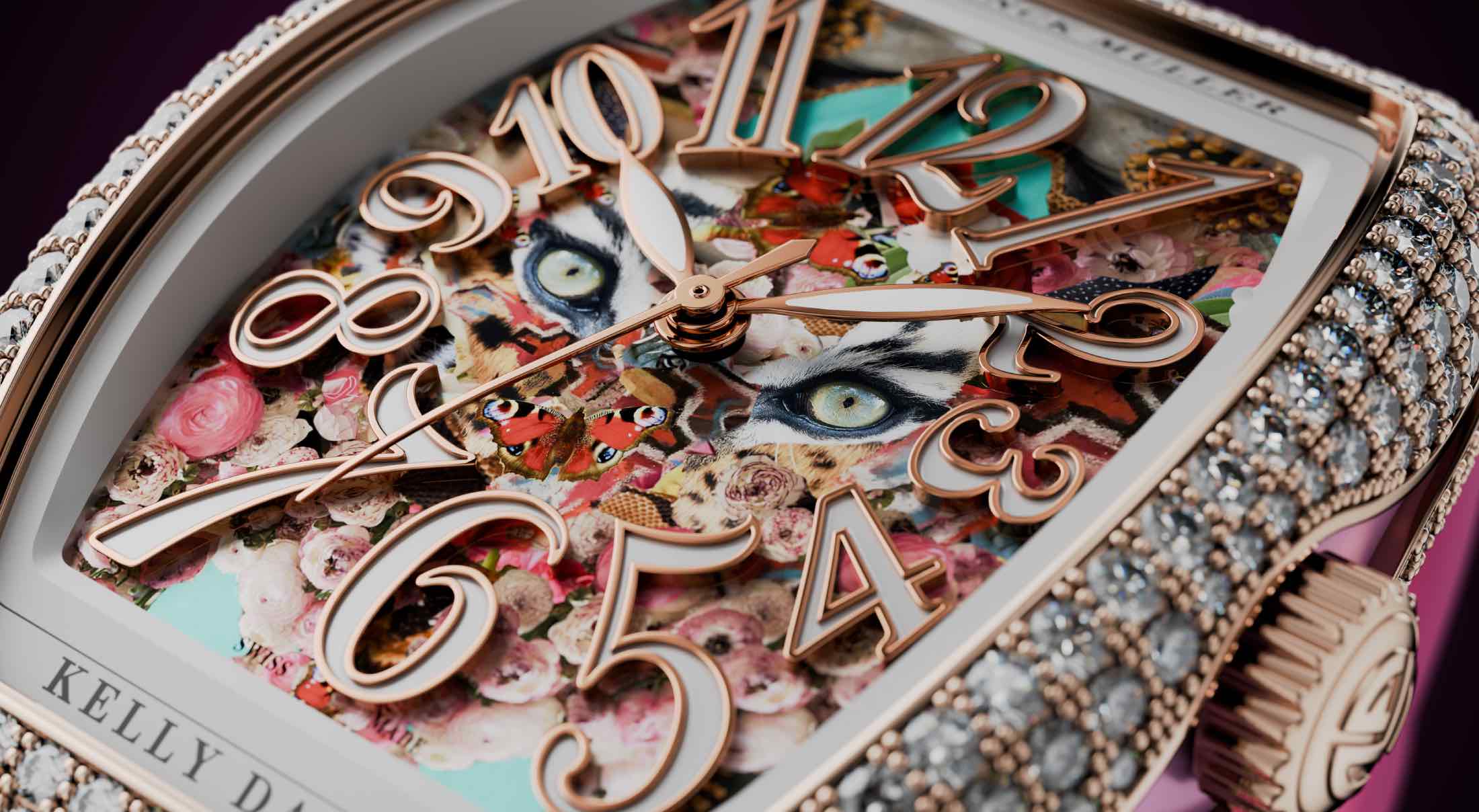
The Vanguard Candy Mint is imbued with playful femininity, with mint green and baby pink tones framing a dreamlike collage. An image of a tiger’s gaze, rendered at the centre of the dial, introduces an almost hypnotic effect beneath the soft allure, while the layered fibreglass case adds depth, texture, and visual richness.
The Vanguard Electric Feel channels Dabbah’s language through a restrained masculine palette, with collage elements embedded into the numerals and electric blue accents that energise the dial.
The same artistic disruption appears in the Vanguard Lady Crazy Hours Jisbar, which builds on the original Crazy Hours x Jisbar unveiled in 2025.
While the first collaboration placed Jisbar’s colourful, quirky universe within a 42.5mm Vanguard case, this new interpretation is rendered in feminine proportions, with a revisited palette and a compact presence on the wrist.
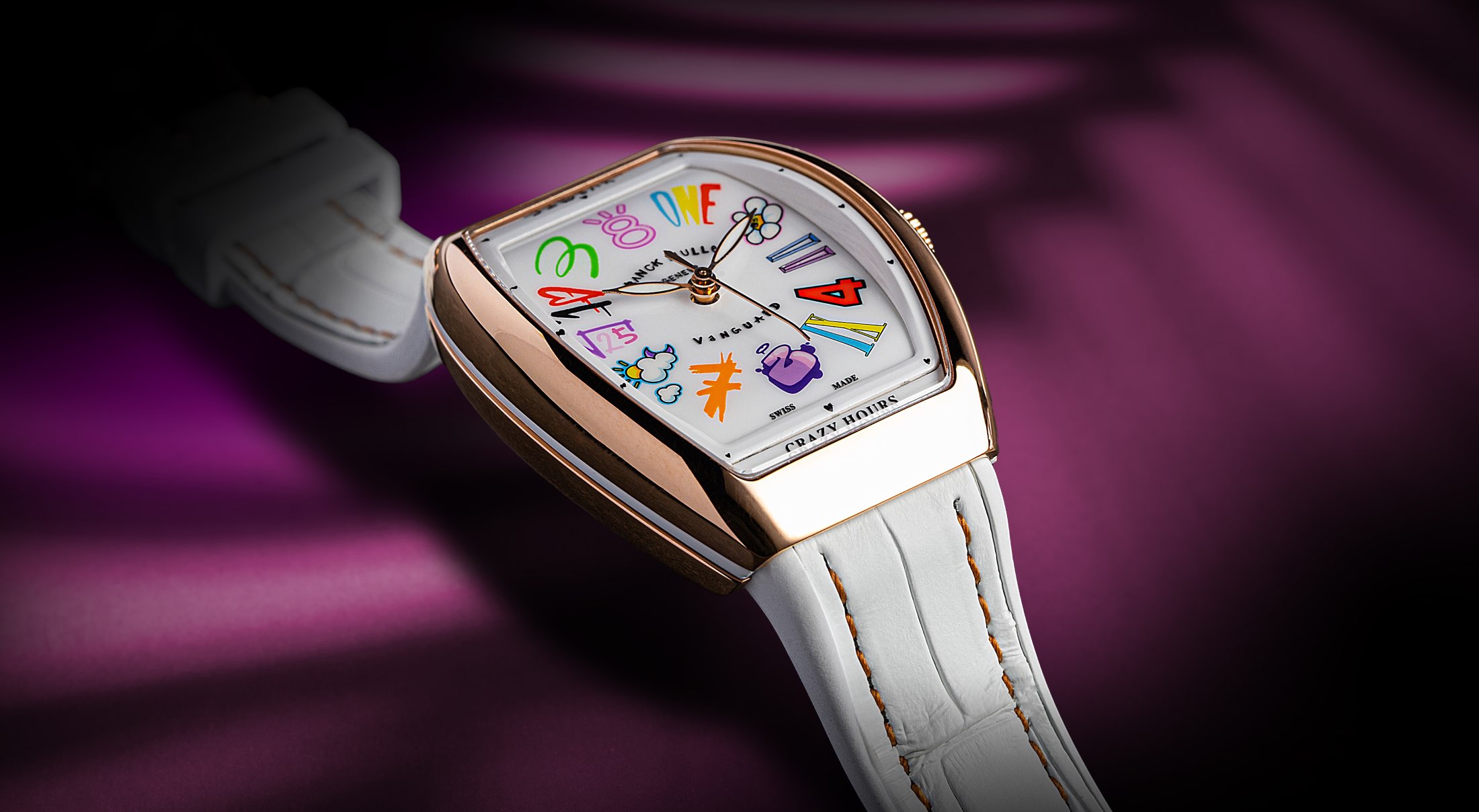
At its core is one of Franck Muller’s most recognisable complications. Crazy Hours arranges the numerals in a seemingly random order, while the jumping-hour mechanism allows the hand to leap to the correct hour. In Jisbar’s hands, the dial is treated as a miniature canvas, where each numeral carries the imprint of the artist’s visual universe, and where colour, symbols, and graphic fragments come together in an energetic composition.
Always energetic and rarely composed, Franck Muller has long possessed a flair for the theatrical. With the novelties released at WPHH 2026, the brand is once again flexing its creative muscles, espousing the belief that when it comes to expression, more can indeed be more.
This story first appeared in the August 2026 issue. Purchase it as a print or digital copy, or consider subscribing to us here